Taya
Every Filipino childhood contains the same theology, and it is shouted, not preached. Langit, lupa, impyerno — im, im, impyerno! Heaven, earth, hell. One child is taya — “it” — and the rest scramble for elevation, because the rules of the game are the rules of the country: whoever gets to higher ground first is safe. Whoever is left standing on the earth can be caught. Nobody ever explains this to you. You learn it at six years old, barefoot, laughing, and you spend the rest of your life discovering it was never a game.
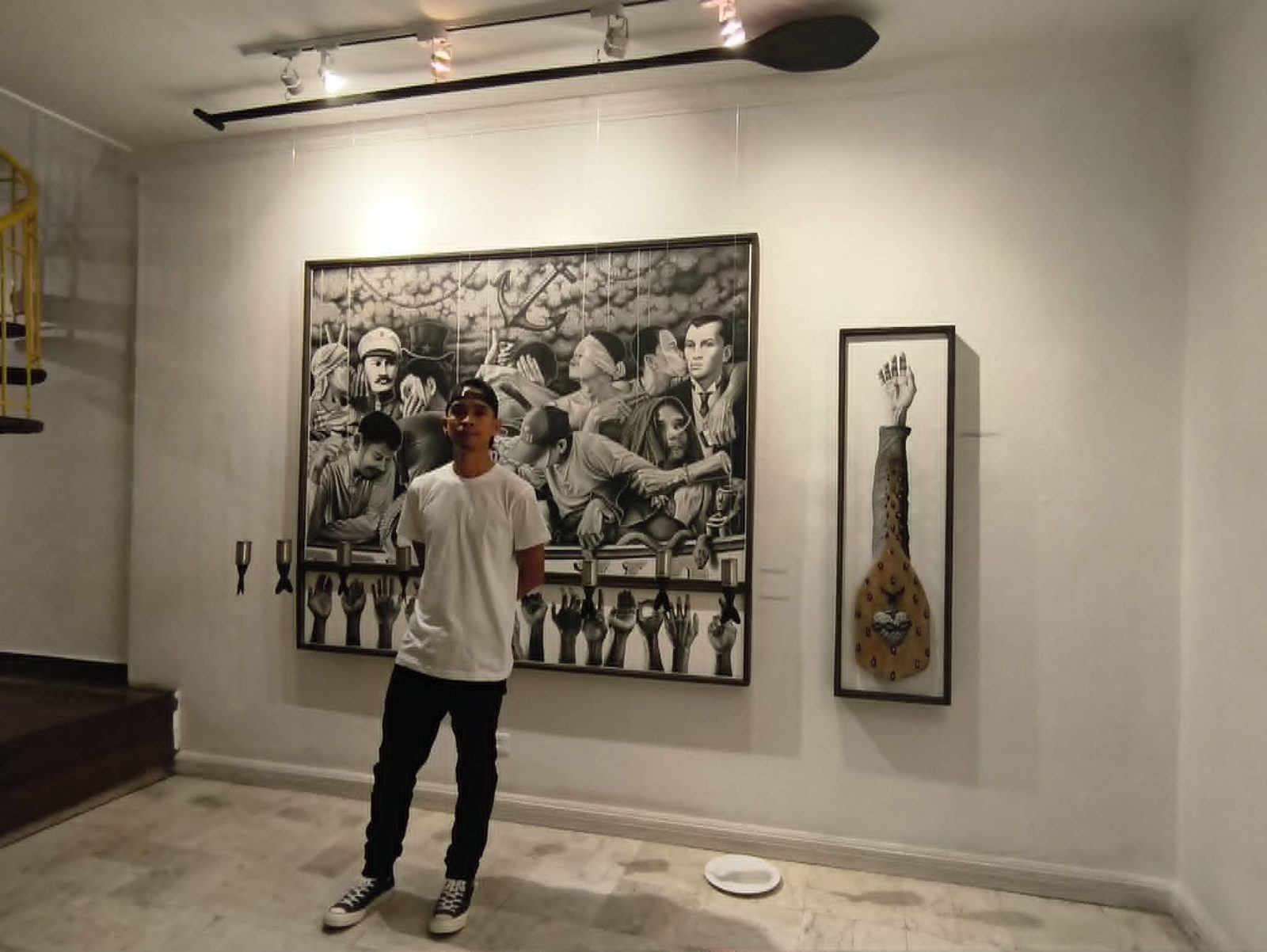
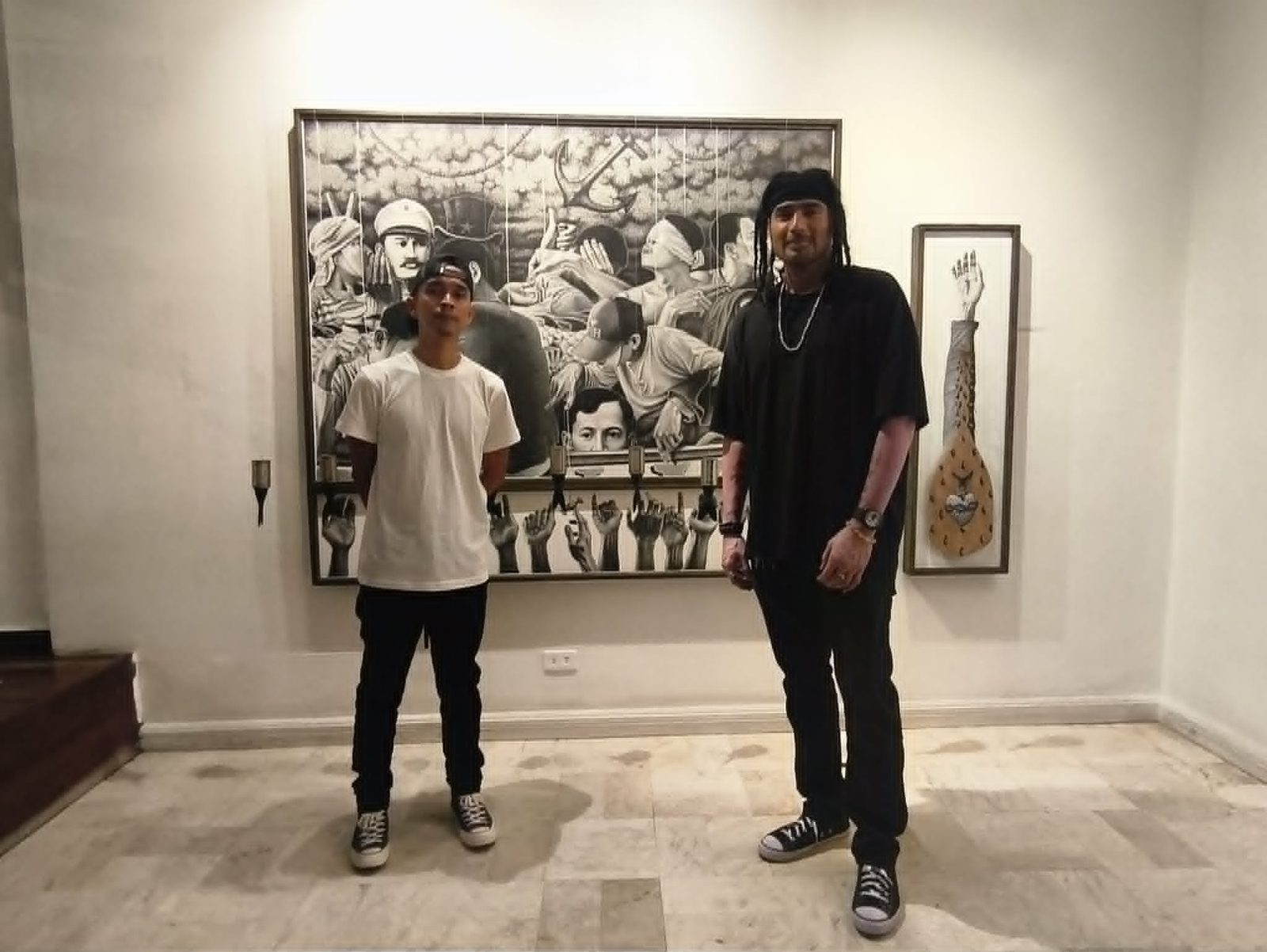
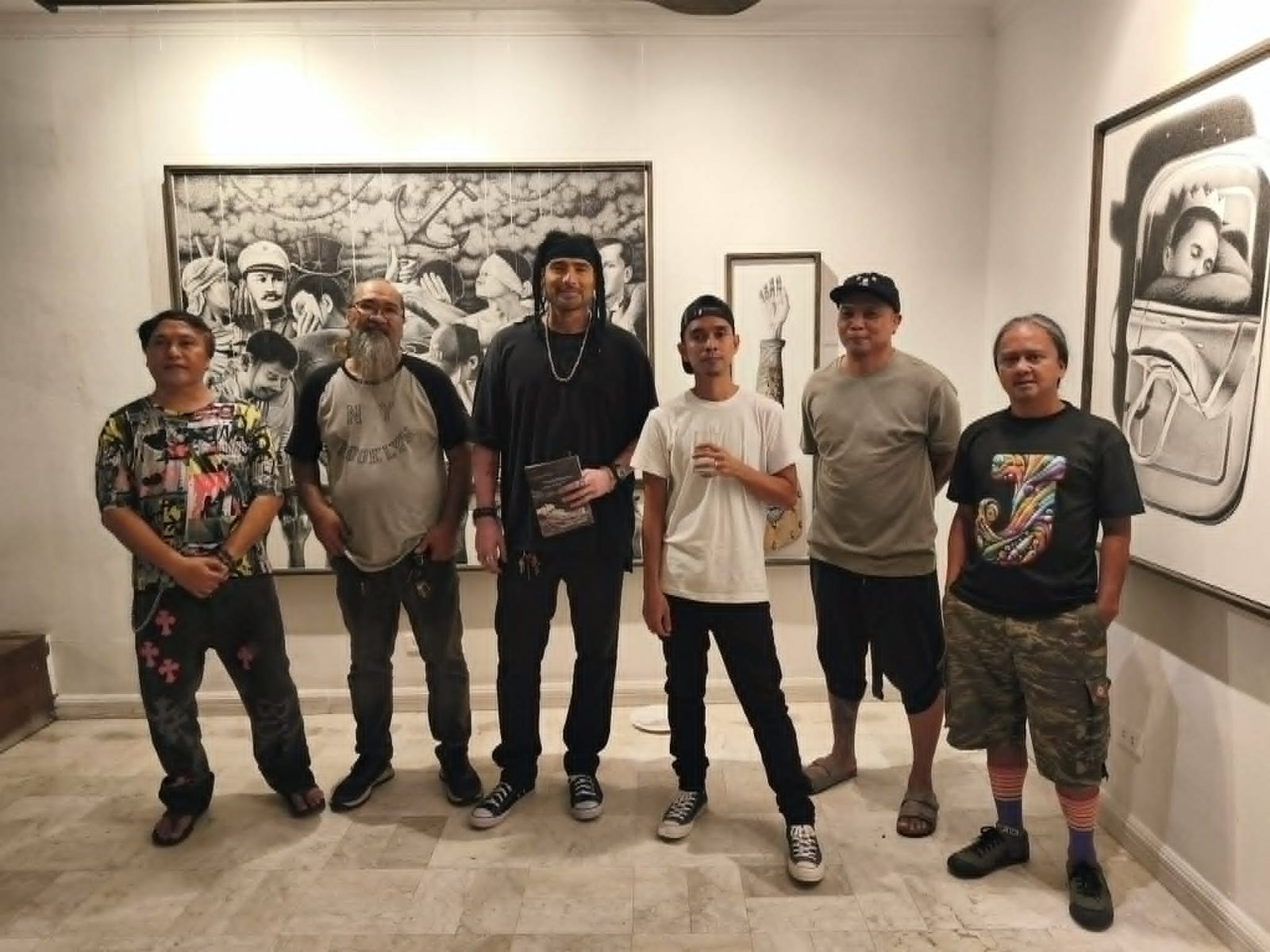
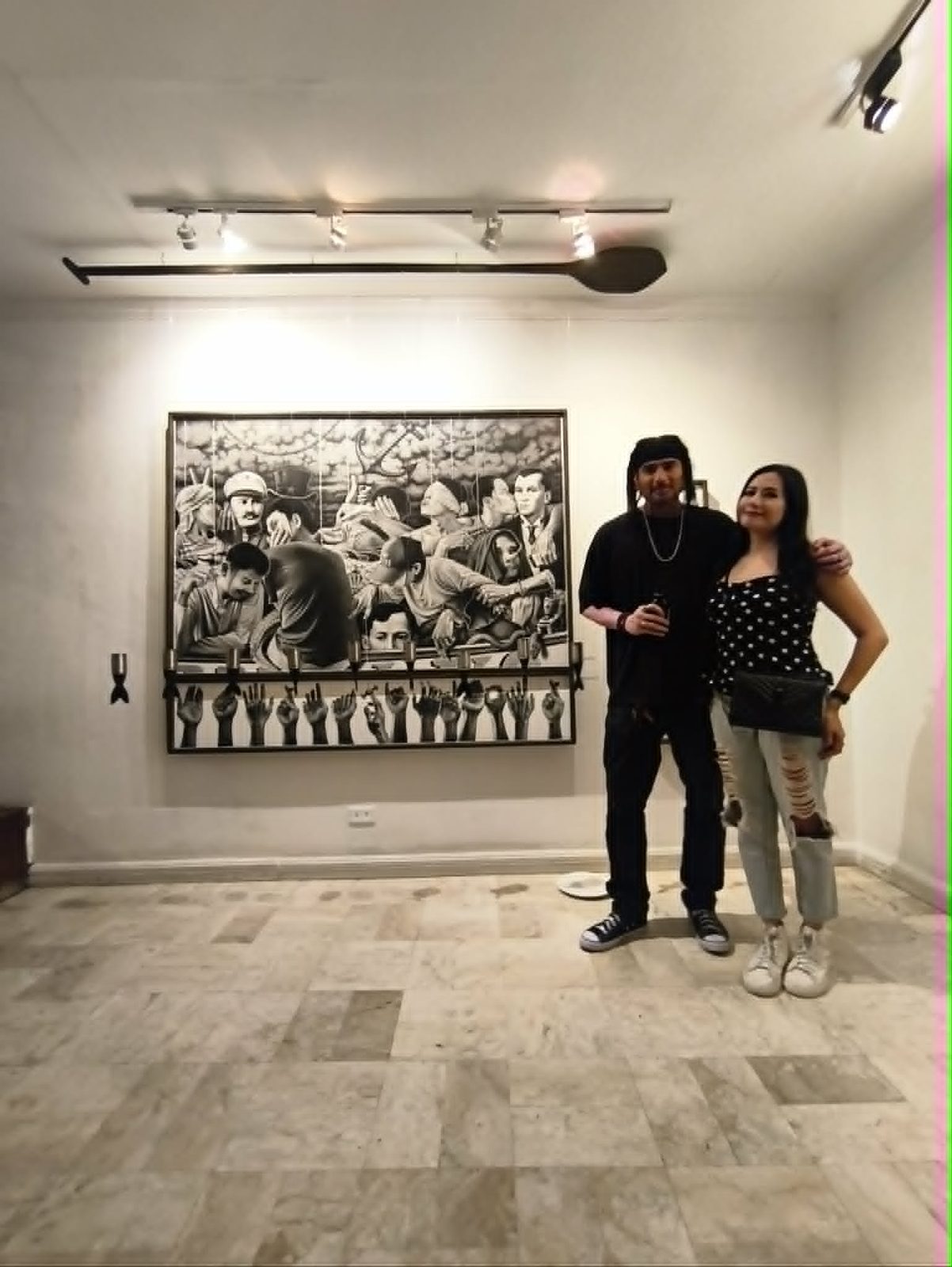
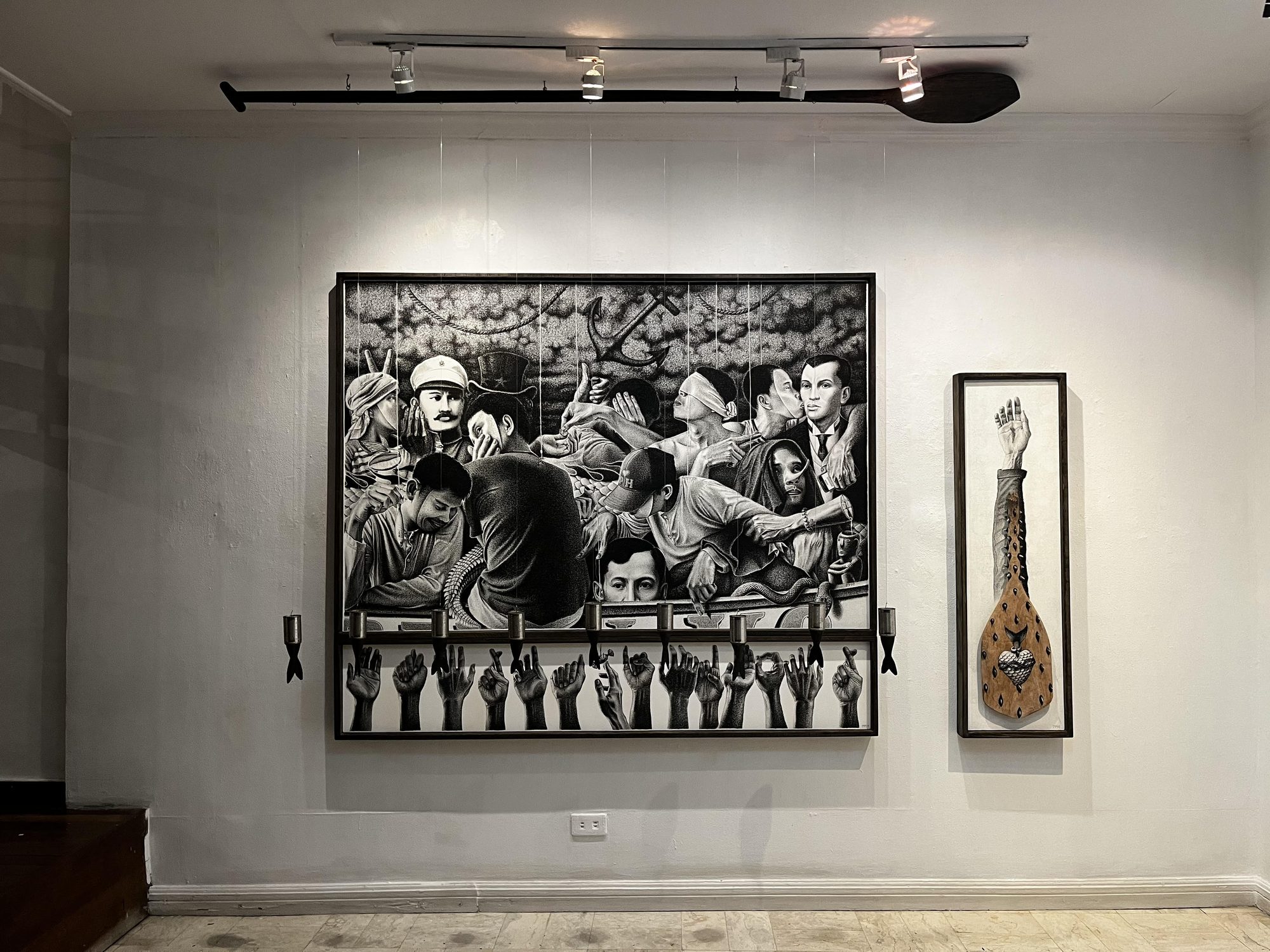
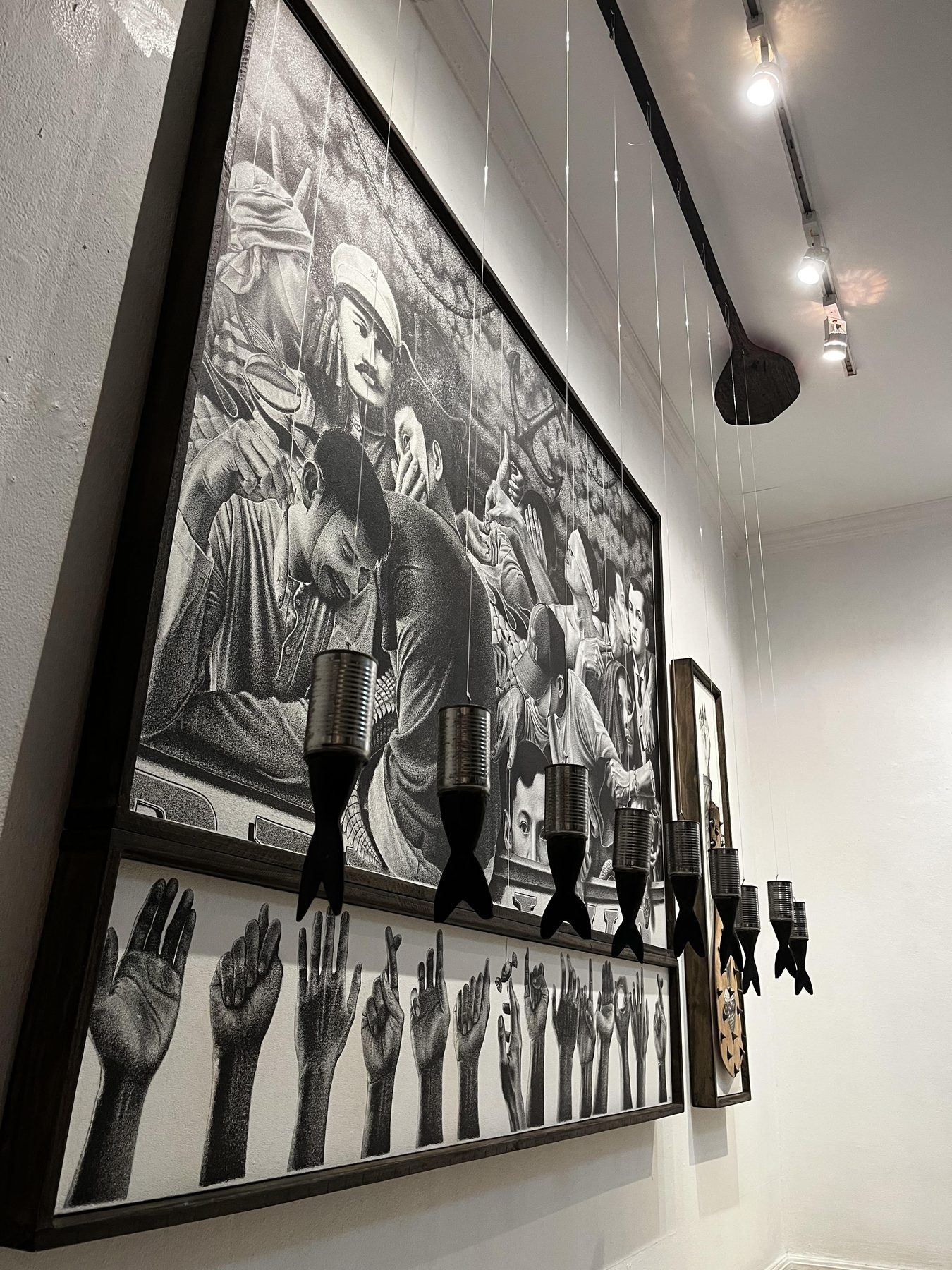
Jonathan Madeja has titled the central installation of his new exhibition Langit Lupa, and standing before it at the Boston Art Gallery — that stubborn, beloved outpost on Boston Street in Cubao that has been quietly serving Philippine art since long before “artist-run space” was a hashtag — I felt the specific vertigo of being tagged. Above your head, mounted along the ceiling like a rafter of the house you grew up in, hangs a sagwan, a wooden boat paddle. Below it, a monumental drawing of a crowded vessel. Below that, a frieze of raised hands. And suspended between heaven and earth, dangling from near-invisible nylon lines like the endless middle syllable of im-im-impyerno, are tin cans — sardine cans — fitted with black tail fins so that they read, in the same blink, as fish and as falling bombs.
A can of sardines that is also a fish that is also a bomb. If you want to understand the last hundred years of the Filipino coastal poor in a single object, there it is, spinning slowly in the gallery’s air conditioning.
The exhibition is called Walang Katapusang Alon sa Dagat — “The Endless Waves of the Sea” — and it opened on the fourth of July, a date that used to be our Independence Day until we remembered whose independence it actually celebrated and moved ours to June. I choose to believe Madeja knows exactly what he is doing with that calendar. Everything else in this show is that deliberate.
The Boy from Alad
First, the biography, because in Madeja’s case the biography is the medium.
Jonathan Madeja was born in 1988 on Alad, a small island off Romblon, into a family of fishermen — which is to say, into a family whose office was the sea and whose salary was decided nightly by the moon, the weather, and the market price of other people’s appetites. He fished. He knows the weight of a wet net at four in the morning, the arithmetic of diesel against catch, the way a good haul can be erased by a bad buyer. He later migrated to Metro Manila and did the full curriculum of the provincial arrival: construction, factory shifts, selling electrical appliances to people who could afford them. He is self-taught. His instrument of choice, then and now, is the ballpoint pen — the cheapest drawing tool ever mass-produced, the pen of jeepney manifests and sari-sari store ledgers and love letters passed in fourth-period class.
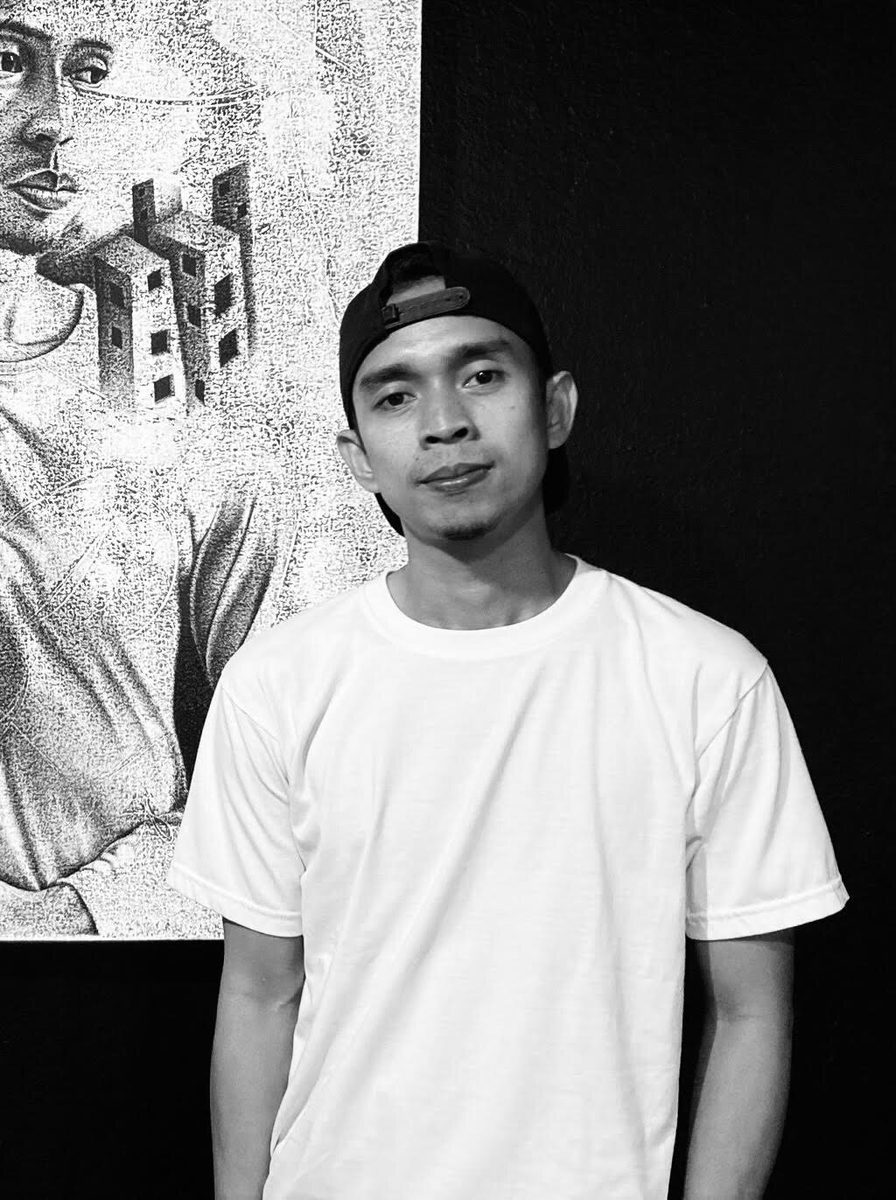
Consider what that choice means technically before we get to what it means politically. A ballpoint pen does not blend. It does not forgive. There is no undo, no turpentine, no scraping back to white. Tone can only be built the way coral is built: by accumulation. Every grey in this exhibition — and Madeja’s greys are oceanic, ranging from moonlit vapor to abyssal black — is composed of thousands upon thousands of individual scribbled strokes, laid down in patient, circling gestures until darkness accretes. Up close, his skies dissolve into static; his skin tones into weather. Step back and they fuse into forms so volumetric they seem lit from within.
Critics like to call this technique obsessive. I think that misses it. Obsession is compulsive; this is devotional. Anyone who has ever mended a fishing net knows the state of mind Madeja draws in — the small repeated motion, hour after hour, that is both labor and prayer, and that only reveals its purpose when the whole is finally held up to the light. He has simply exchanged nylon for ink. The net still catches.
And here is the beautiful, quietly devastating conceit of the entire show: the scribble is the wave. Each stroke is a small crest that amounts to nothing alone. Millions of them together become an ocean that can carry a boat or swallow it. Madeja has found a technique that is his subject — endless small repetitions, indistinguishable from each other, relentless, cumulative, capable of tenderness and capable of drowning you. Tell me that isn’t also a description of Philippine history.
The Ship of State Has a Leak
The exhibition’s flagship — literally — is Kargado (pen and archival ink on canvas, 48 x 72 inches, 2026), and it deserves to be discussed the way we discuss Juan Luna’s Spoliarium: slowly, and with the lights on.
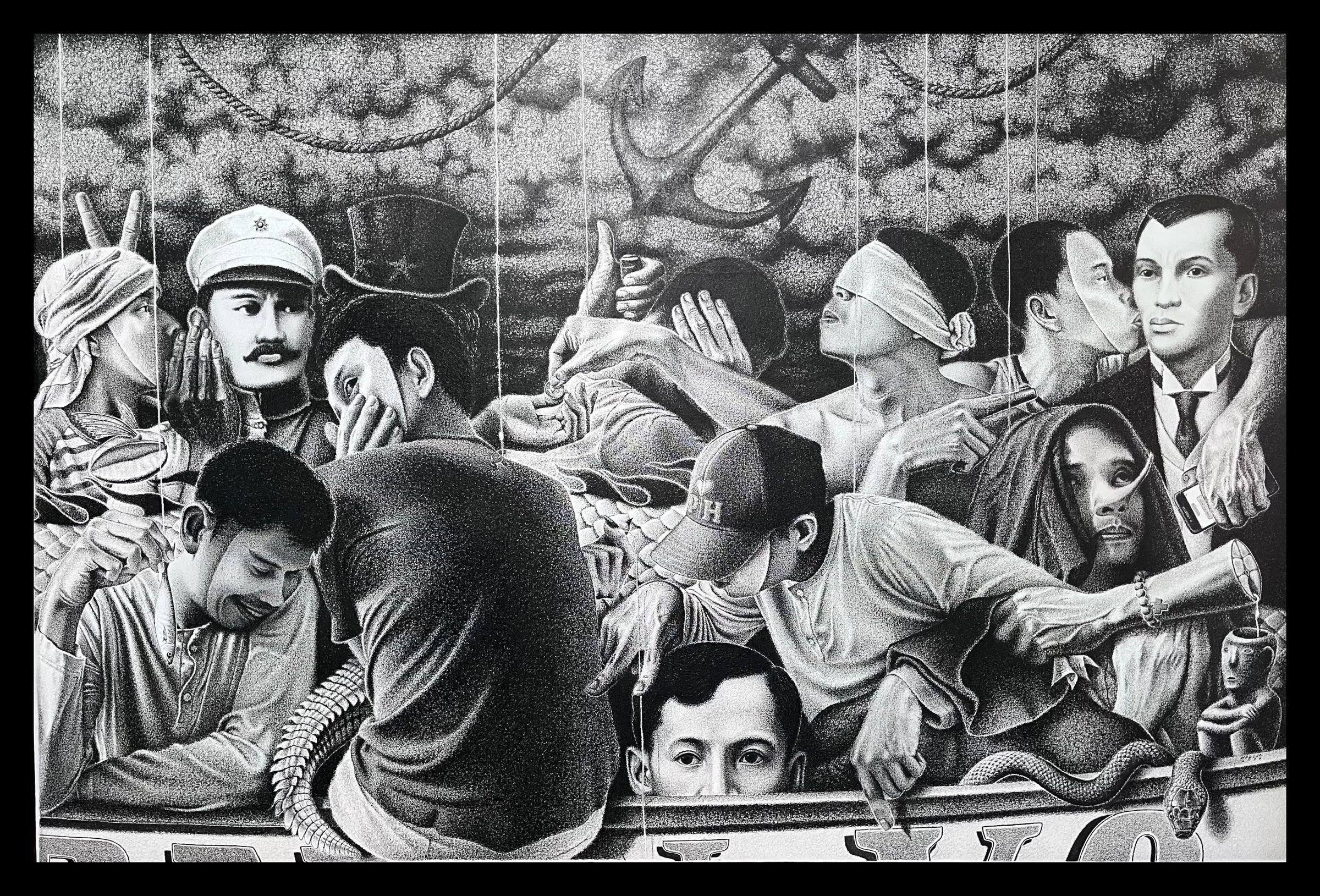
The title means “loaded,” and the word does triple duty in Filipino: a boat loaded with cargo, a gun loaded with bullets, a person loaded with drink or debt or fate. Madeja gives us all three. The figures crowd the deck of a bangka under a sky of stippled stormclouds, where an anchor floats among the cumulus like a dark constellation. An anchor is supposed to mean hope, stability, grounding, safety — but here it floats above the boat instead of securing it, which flips the symbol into something ironic and unreachable: hope suspended overhead like something that might fall on you. It reads as a nation searching for its footing and unable to find it, kept adrift by history, corruption, betrayal, and instability. A coiled rope drifts beside it, going nowhere.
And the passengers. Dios mío, the passengers. Three of our national heroes ride this boat, and Madeja scatters them deliberately. At far right stands a figure every Filipino will recognize before their brain finishes the thought — the side-parted hair, the black suit, the high collar, the level, sorrowful gaze. This is Andrés Bonifacio, the Supremo, rendered with the fidelity of a schoolroom portrait. Someone is kissing his cheek. Look closer, as the medium demands, and the kisser’s hand is slipped around behind him, clutching a smartphone — the Judas kiss, updated for the age when betrayal comes with a front-facing camera. If you know how Bonifacio’s own revolution turned on him, you know that this kiss is the oldest wound in our politics. Nearby, a general in a white peaked cap and waxed mustache — Antonio Luna, the ghost of our revolutionary officer class — receives a whisper behind a cupped hand, and if you know what happened to Luna in Cabanatuan you know that whispers behind cupped hands are how we kill our best men. And José Rizal is here too, easy to miss: only a half-face, partially visible low in the crowded boat, watching from beneath the others, as the quiet conscience of the vessel.
The rest of the deck is a bestiary of the body politic. A gloved figure in a star-spangled top hat hides his face. A young man is blindfolded with a rag, chin lifted, as if being asked to identify his abusers by voice alone. A hand at the gunwale casually pours liquid into the hollowed head of a bulul, the ancestral rice deity reduced to a drinking vessel — four centuries of colonization summarized in one bar trick. A crocodile — buwaya, our enduring shorthand for the greedy, the corrupt, the predatory official who feeds on the people — lurks in the composition. A balimbing, the many-sided starfruit whose name we give to political turncoats, hangs as a small emblem of shifting loyalty and opportunism, of men who show a different face to whoever holds power. A snake glides along the boat’s painted rail. An ammunition belt lies coiled like a centipede sunning itself. And a small herring-like fish, recalling tuyo — the salted dried fish of ordinary Filipino meals — carries its own charge: the food of poor households, and with it hunger, survival, working-class life, and the daily economy of making do.
But the figure that undoes you — the one I keep returning to — is the smallest. At the bottom center of the composition, a boy’s face rises just above the boat’s edge, only his eyes and the top of his head visible, watching everything. Above him, a man in a cap embroidered with a heart and the letters “PH” leans over the side, reaching down. Whether he is pulling the boy up or pushing him under is precisely the question the painting refuses to answer, and precisely the question every Filipino generation must answer about the one below it.
And here is the turn that keeps Kargado from being mere allegory: several of these figures can be read as versions of the artist himself. The repeated young men, the watching boy — Madeja seems to be scattering self-portraits through the crowd, placing himself inside the national narrative rather than narrating it from the shore. Some of the figures wear masks or perform different faces, as if the painter were confronting the several selves a poor Filipino must become to survive: the witness, the accomplice, the child, the one who looks away. He is not painting the boat. He is admitting he is on it.
Vertical strings descend across the entire scene — fishing lines, or puppet strings, or the nylon that will hold the sardine-bombs in the installation. In Kargado, everyone is caught on something. The boat is overloaded — with history, betrayal, heroes, corruption, violence, childhood, hunger, and national memory — and no one is rowing, because the paddle, remember, is nailed to the ceiling of the gallery, out of everyone’s reach.
I laughed out loud when I realized that, and it was the kind of laugh you do at a funeral.
A Frieze of Hands, a Candy on a Hook
Directly beneath Kargado in the Langit Lupa installation hangs Kapalaran (pen and archival ink on canvas, 18 x 72 inches, 2026) — “Fate” — a six-foot horizontal frieze of thirteen disembodied forearms rising against white, each hand frozen in a different gesture. Read left to right, it becomes a national sign language: the open palm of pleading or of receiving ayuda; the closed fist of protest; the flat raised hand of oath-taking, that gesture our officials perform so fluently and honor so rarely; crossed fingers, which is what the oath-taking hand is doing behind its back; the Korean finger-heart that our politicians deploy on campaign posters with the aggression of artillery; the okay sign making a hole that money passes through; a fist with pinky raised, the barkada’s promise.

And at the center, the punchline that is also a knife: a single hard candy in a twisted wrapper dangles from a fishhook, and one hand reaches for it, fingers just closing. Vote-buying, patronage, the pakimkim, the five hundred pesos in an envelope on election eve — Madeja renders the entire machinery of our politics as what it has always been: bait. We are a fishing nation; of course our masters learned to fish for us. The candy is drawn with such stippled tenderness, such jewel-like care, that you understand why the hand reaches. It is not stupidity. It is hunger. The painting does not mock the reaching hand. It mourns the hook.
That the hands rise from the bottom edge like the hands of people treading water — or people drowning, the gestures are identical from shore — is the kind of double exposure Madeja achieves constantly and without apparent strain.
The Treasure Is a Weapon Is a Heart
On the adjacent wall hangs the show’s most sculptural statement, Manggad (Kayamanan) (mixed media on canvas, 48 x 13 inches, 2026). Manggad is the Visayan word for treasure, wealth, inheritance. The work is a tall, narrow relief: an actual carved wooden sagwan — a paddle, the same humble tool enthroned on the gallery ceiling — mounted onto the canvas and studded with rows of dark thorns, like the bakunawa’s spine or a war club from the pre-colonial armories our textbooks skip. On the paddle’s blade, Madeja has drawn a sacred heart armored in fish scales, bound in a crown of barbed thorns, with a fish’s tail rising from its top where the flame of the Sagrado Corazón should be. Above the paddle, emerging from a stippled sleeve, a hand rises open-palmed in the manner of benediction or surrender — and in the center of the palm, where the stigmata belongs, rests a single tiny fish.
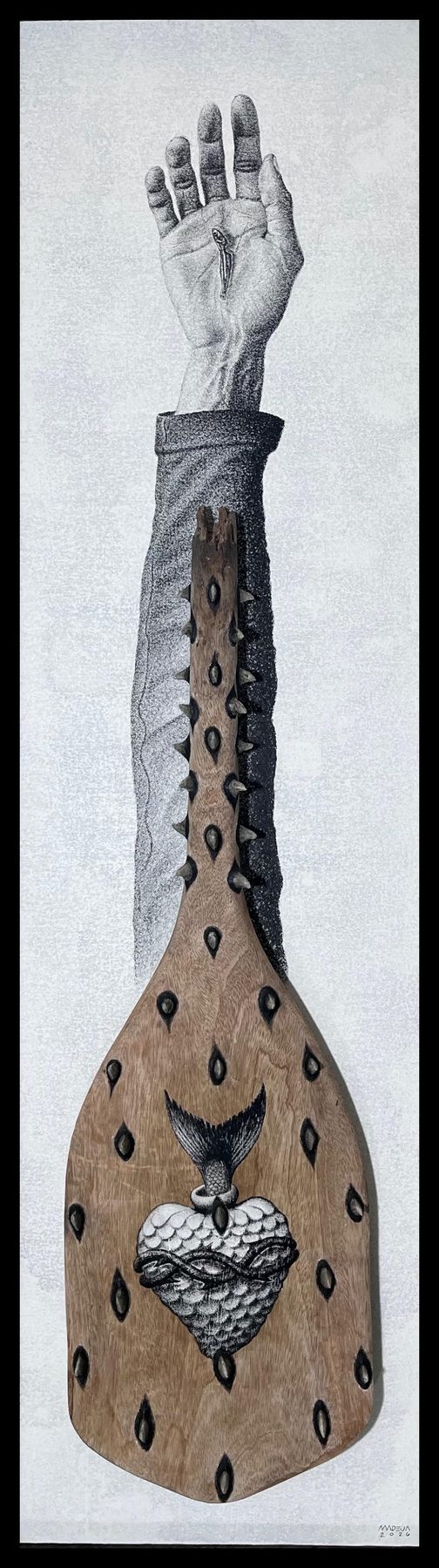
I stood in front of this piece for a long time, and a tita beside me at the opening said, softly, to no one in particular: “Parang relikya.” Like a relic. She is right. This is a reliquary for the Filipino fisherman — his tool made holy, his wound made visible, his catch made sacrament. The inheritance (manggad) our coastal families pass down is exactly this trinity: a paddle, a pierced heart, and a fish too small to sell. That Madeja, a fisherman’s son, carved and thorned and consecrated this object with his own hands moves it out of metaphor entirely. This is not a work about his family. It is his family, transubstantiated.
Two Fish, Unequal Before the Law
The wittiest work in the exhibition — and its most surgically political — is Kabaligtaran (pen and archival ink on canvas, 12 x 35 inches, 2026), whose title means “the opposite,” “the reverse.” It is a diptych hinged around a carved wooden post inlaid with tiny stars, like a page-turn in a book, or the post of a fish stall. On the left panel: a small, silvery fish — a galunggong, the round scad, officially designated “the poor man’s fish” by people who have never had to be poor — swimming alone in a vast black sea, drawn white-on-dark, glowing like something precious. On the right panel, the values invert: a huge, magnificent grouper — a lapu-lapu — rendered dark-on-white, filling its panel wall to wall, enthroned in negative space.
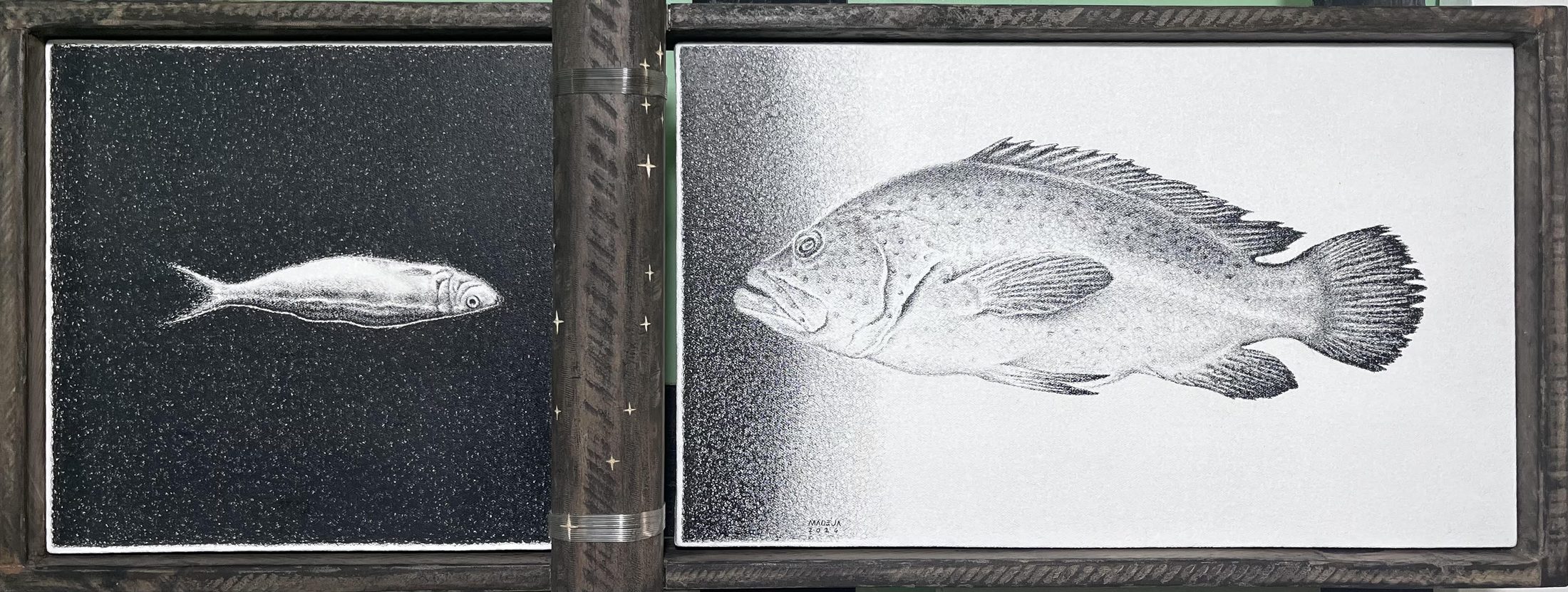
Sit with the reversals. The cheap fish is given the luxury treatment: darkness, mystery, starlight, room to swim. The expensive fish is pinned against clinical white like a specimen, or a menu photograph. The small fish is free and the great fish is caught, because in this country only the poor man’s fish is left in the ocean; the prime catch is spoken for before it leaves the water. And the crowning irony, which Madeja does not need to write on any wall label because every Filipino carries it pre-installed: the grouper is named lapu-lapu, after the chieftain of Mactan, the first Filipino to win a battle against empire. We named our most expensive fish after our first hero, and then priced him beyond the reach of the fishermen who are his descendants. The men who catch lapu-lapu eat sardinas. If you want to know what happened to the revolution, it is right there, hinged and starred, thirty-five inches wide.
Sardinas, or The Architecture of Making Do
Which brings us to the tin cans, and to the two works in this show that will break you gently.
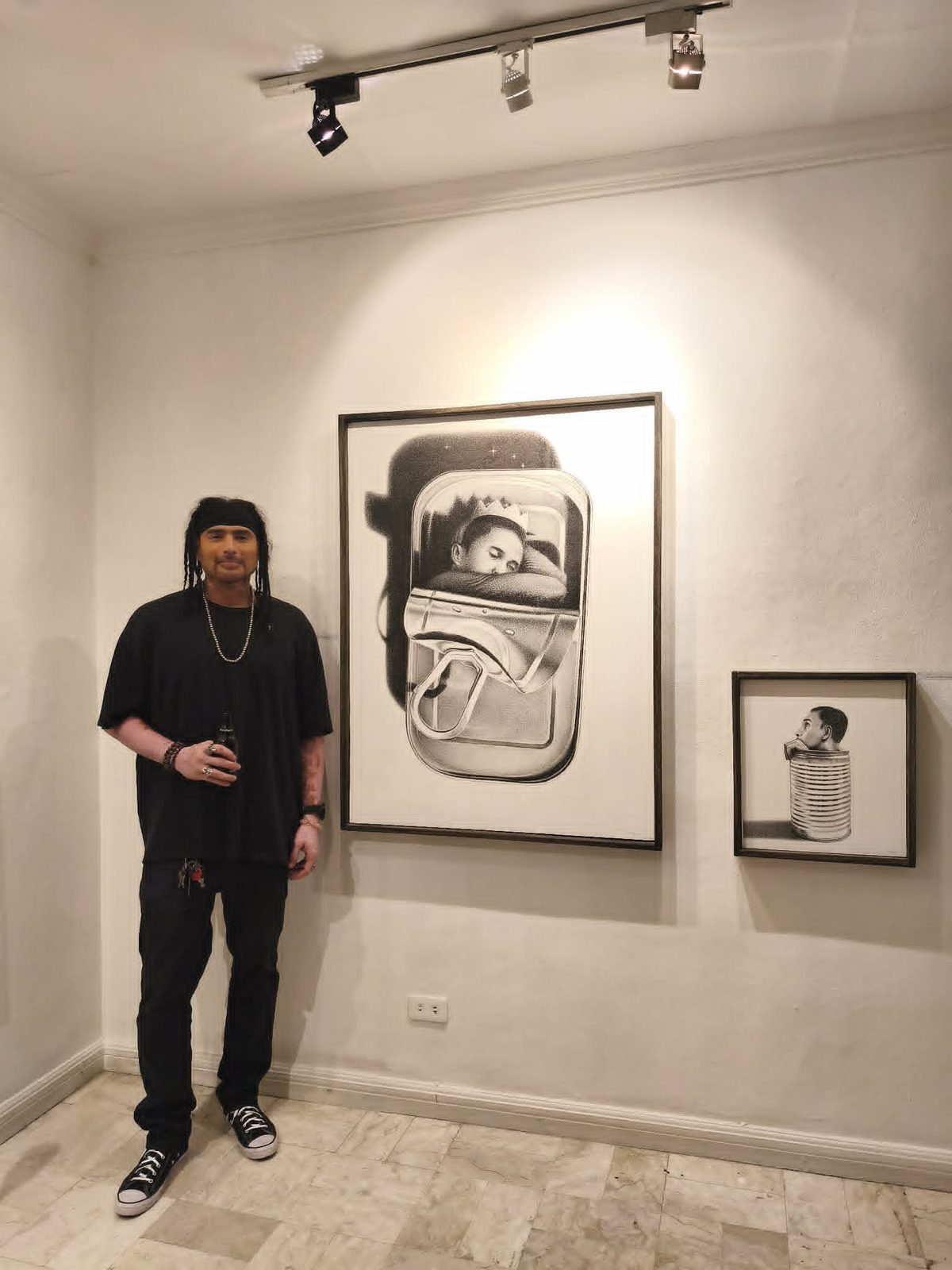
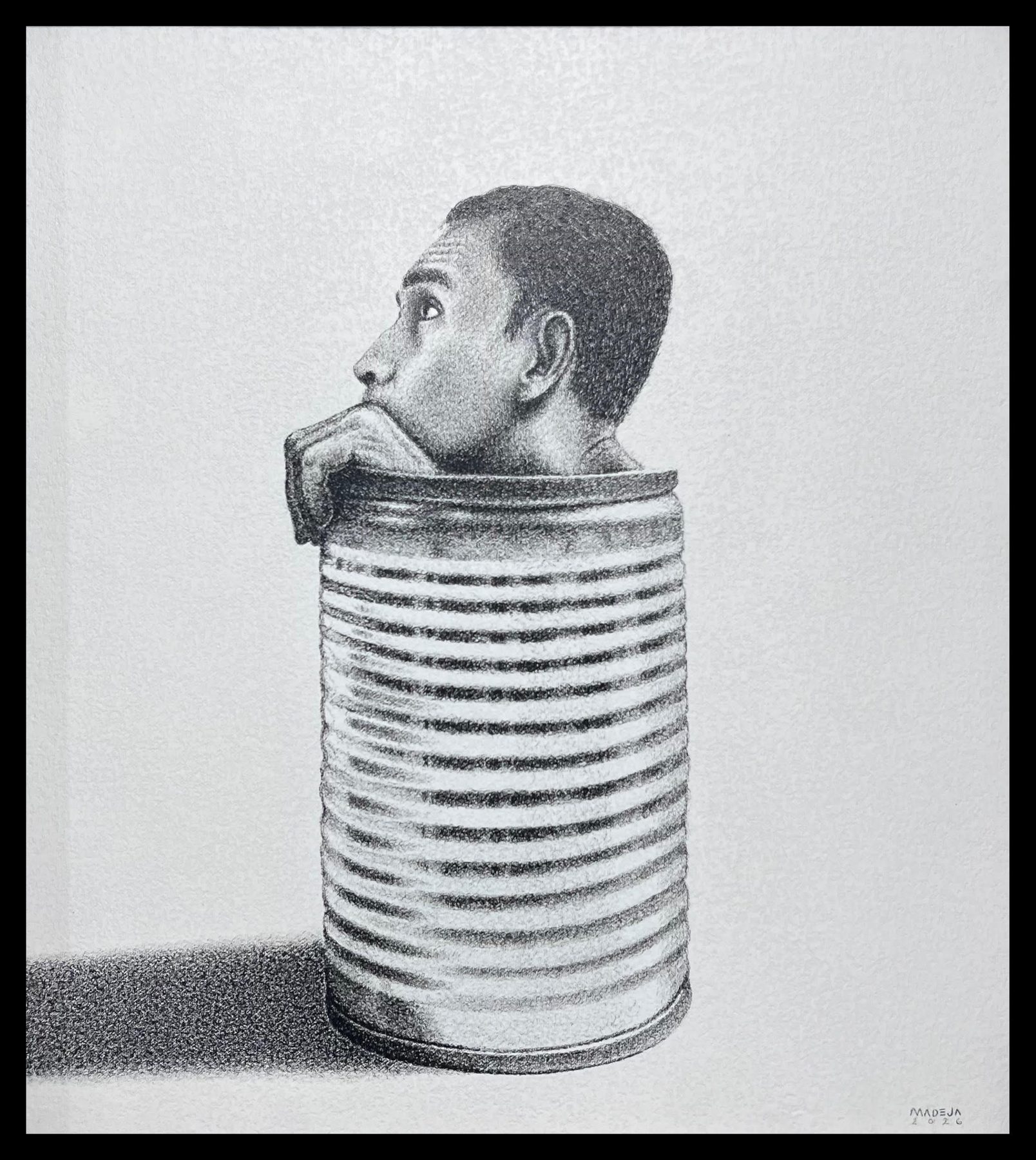
Lata (pen and archival ink on canvas, 18 x 16 inches, 2026) — “Tin Can” — gives us a man folded impossibly inside a corrugated can, only his head and one fist emerging, chin propped on knuckles in the exact posture of Rodin’s Thinker, eyes lifted upward with an expression suspended between hope and hala. It is very funny — the composition has the deadpan of an editorial cartoon — right up until it isn’t. Because the can is the barong-barong, the bed-spacer’s cot, the OFW’s bunk, the studio apartment marketed as “cozy.” The can is every Filipino life lived inside a container designed by someone else, sized by someone else, priced by someone else. And still: the man thinks. The man looks up. Madeja has stippled the can’s corrugations with a metalworker’s love, dozens of parallel ridges catching light, as if to say — and this is the artist’s most radical tenderness — even the can is beautifully made. Even here, craft. Even here, dignity.
Then he raises the stakes. Tala (pen and archival ink on canvas, 48 x 36 inches, 2026) — “Star” — is a sardine can four feet tall, its lid peeled back with the pull-tab ring curling below like a heart-shaped monogram, and inside, where the sardines should be packed, a boy sleeps. He wears a paper crown, slightly crumpled, the kind cut from a birthday hat or folded from an exam paper. His cheek rests on his own arms. Behind the can, its shadow spreads on the wall — and inside that shadow, Madeja places small stars, as if the boy’s dream has leaked out of the tin and into the darkness around it.
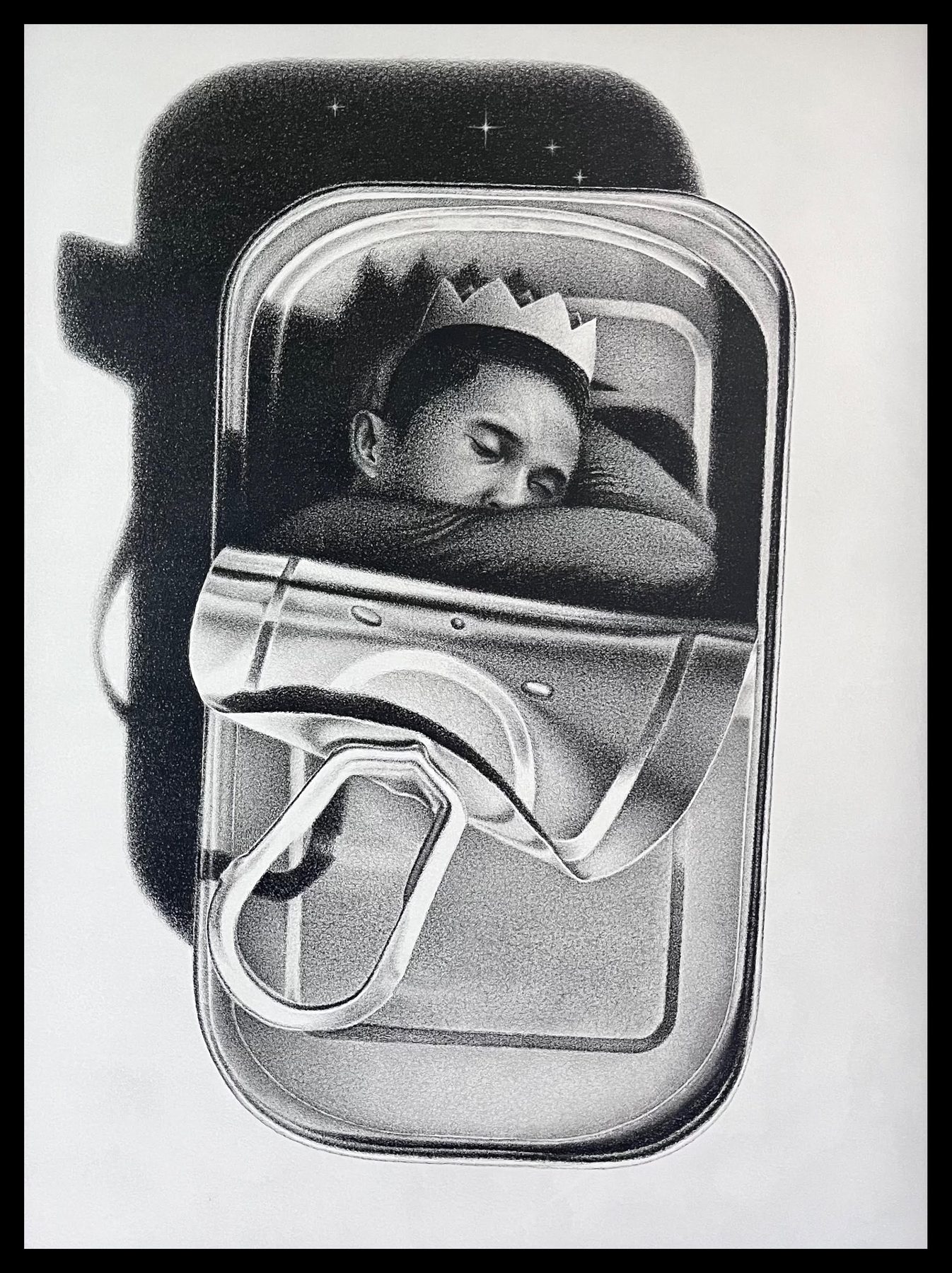
I will tell you what this painting is. It is every child who fell asleep at the table while the adults counted the day’s earnings. It is every one of us who was told matulog ka na, prinsipe — go to sleep, my prince — in a house where the ulam was, in fact, sardinas, again, forever, and where our parents crowned us anyway. The can that in Langit Lupa becomes a bomb, and in Lata becomes a cell, here becomes a cradle. Same can. It is the single most economical image of Filipino childhood poverty and Filipino parental love I have encountered in years, and Madeja drew it — I must keep insisting on this — with a ballpoint pen, one whispering stroke at a time, over what must have been hundreds of hours. A man spent months of his one life shading the inside of a sardine can so that a sleeping child would have somewhere soft to lie. If that is not love, I no longer know how to identify it.
What the Fisherman Carries in the Dark
The show’s tenderest register continues in Aninipot (pen and archival ink on canvas, 30 x 29 inches, 2026), titled with the Visayan word for firefly. A young man — the artist’s recurring self-figure, in the plain long-sleeved shirt of every probinsyano who has ever waited for a bus — stands at night in a grove of old, gnarled trees, cupping in both hands a curved husk that cradles a single leaf. The leaf glows. It illuminates his chest, his downturned face, his careful fingers, while all around him fireflies hang in the black air like a low, private galaxy.
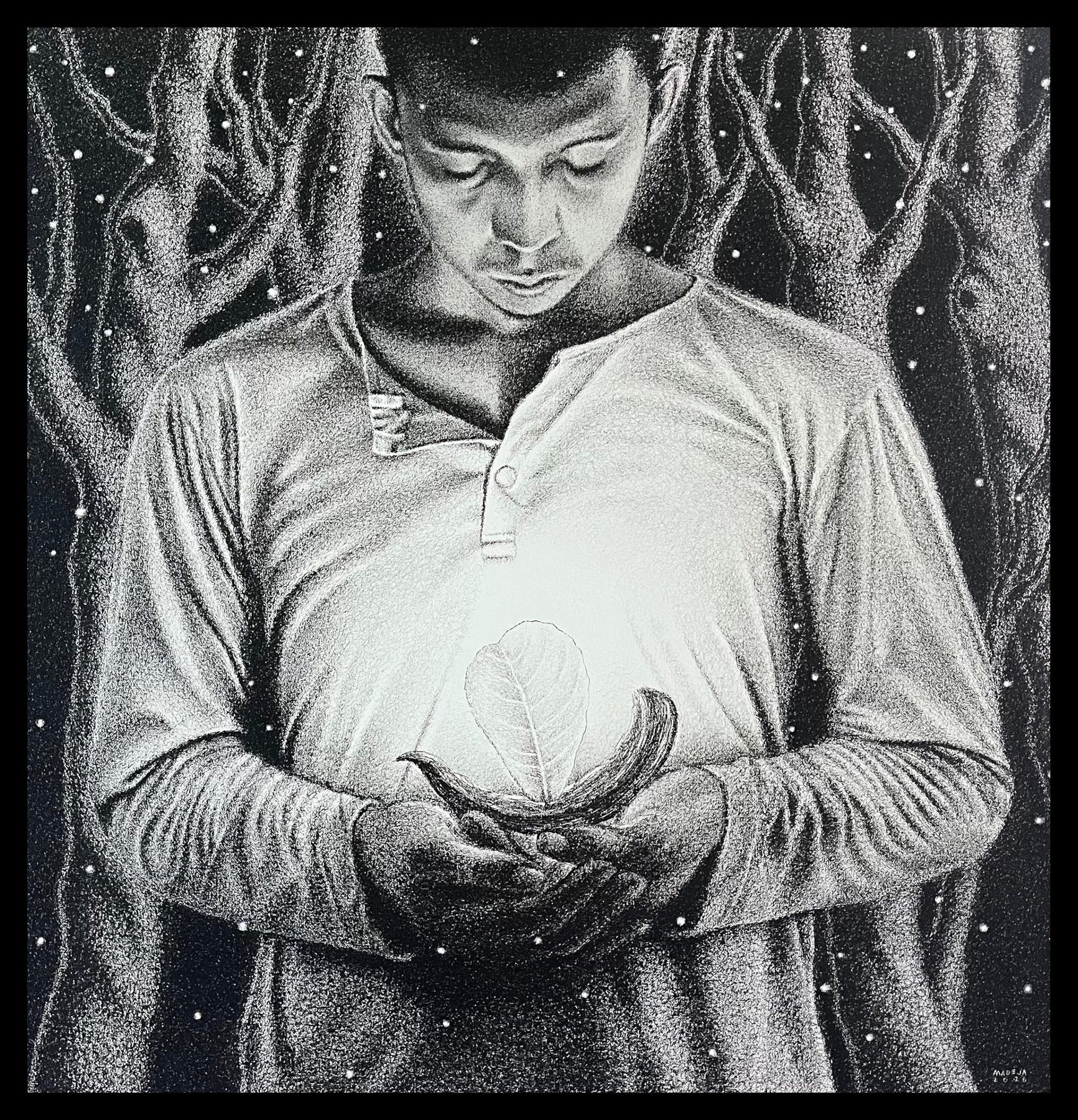
Anyone raised on an island before full electrification knows this image is not invented. This is memory, direct and unprocessed: the walk home through the trees, the fireflies that meant clean air and clean water (they vanish when either fouls — the aninipot is the honest environmental auditor no administration can bribe), the child’s discovery that light can be held. Madeja paints his own boyhood on Alad here, but he also paints an instruction. In a show full of storms, betrayals, hooks, and bombs, Aninipot insists that the small light you carry with your own two hands — a talent, a memory, a child, a vow — is navigation enough. It is the exhibition’s quietest painting and its most defiant.
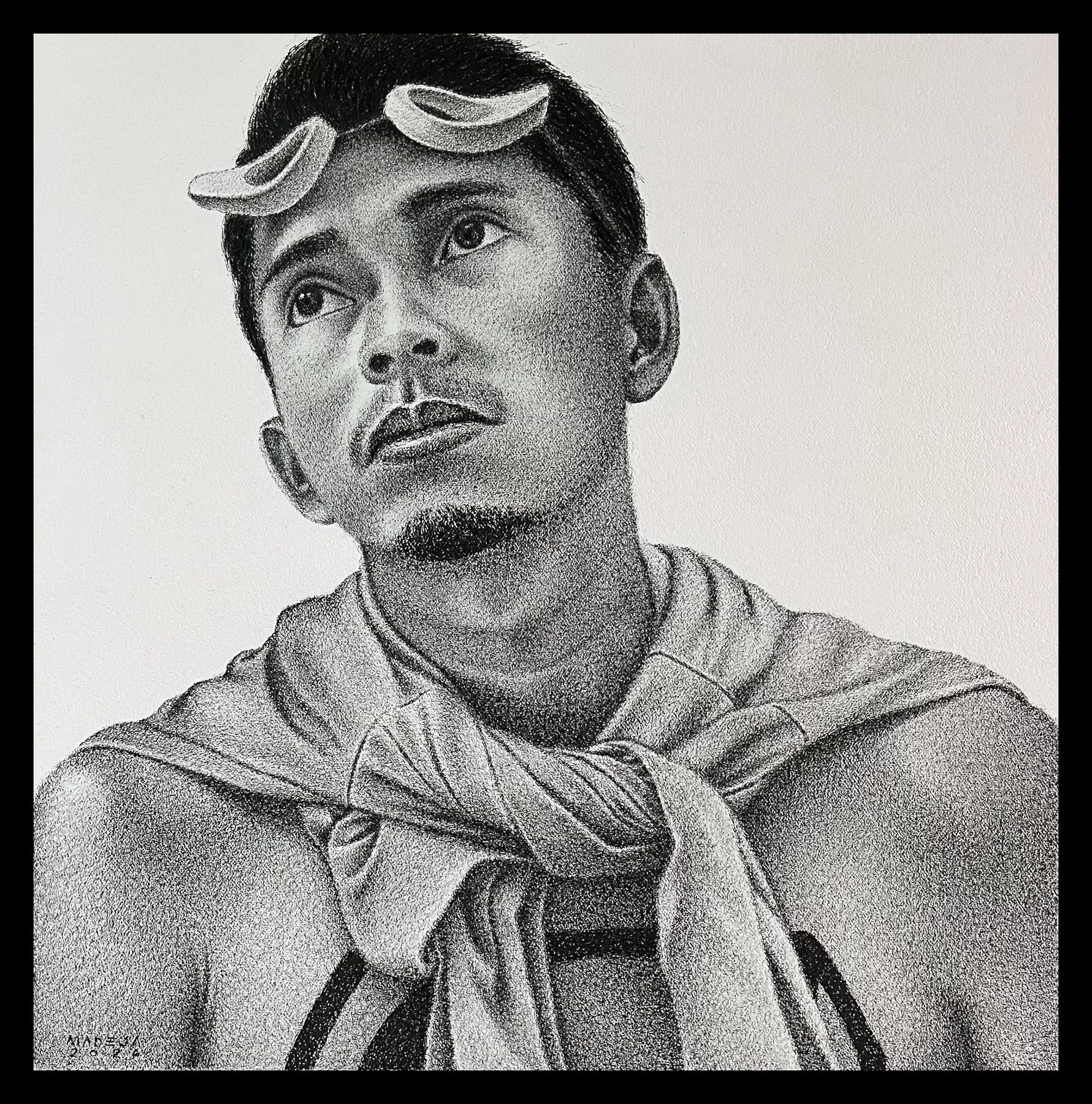
Its companion in dignity is Mandaragat (pen and archival ink on canvas, 18 x 18 inches, 2026) — “Seafarer” — a square portrait of a young fisherman with improvised wooden goggles pushed up on his forehead, their carved eyecups curved like twin crescent moons, a shirt knotted at his throat in the manner of a superhero’s cape worn by someone with actual work to do. He looks up and off-canvas, jaw set, eyes wet with light. It is a hero’s portrait in the full academic tradition — the tradition that gave us haloed saints and laureled generals — except the laurels here are handmade diving goggles, the armor is a cotton shirt, and the hero smells of salt and gasoline. And it may also be read as a portrait of the artist himself: not simply a generic seafarer, but Madeja returning to his own image through the figure of the fisherman, carrying the memory of labor, island life, and survival. Hang this in a classroom next to the portraits of Rizal and Bonifacio. It belongs in the same lineage: men who went out into hostile waters for the sake of people waiting on shore.
The Wave Has an Eye
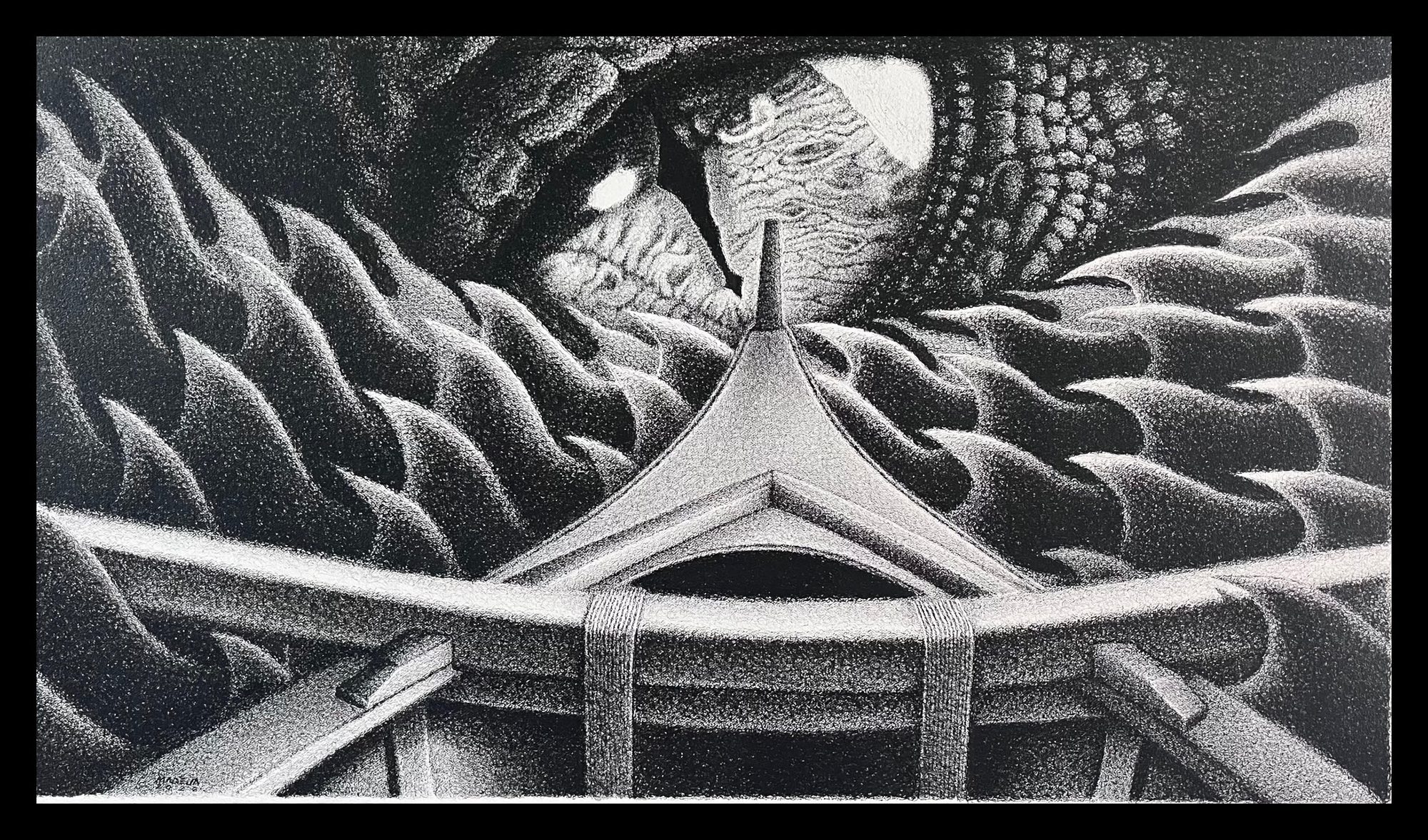
And then Madeja shows us the adversary. Alon (pen and archival ink on canvas, 17 x 30 inches, 2026) — “Wave” — puts the viewer inside the boat: we see the prow of a bangka from the rower’s seat, its bindings and struts rendered with a boat-builder’s precision, pointed directly into a mountainous oncoming sea. But the wave, as it rises, resolves into something else. The swells become scales. The foam becomes a ridged brow. A pale slit gleams where the whitecap should be — an eye — and the whole storm assembles itself into the face of an immense reptilian presence, part bakunawa, the moon-swallowing serpent of Visayan myth, part something more contemporary and more heavily flagged, coiling in the very waters where our fishermen are rammed, hosed, and lasered for the crime of fishing in their own sea. Madeja, who in earlier bodies of work has drawn dragons rising over seas of fishhooks, does not need to write “West Philippine Sea” anywhere. The eye in the wave says it. The tiny, patched, defenseless prow of the bangka — our prow, since we are seated in it — says the rest.
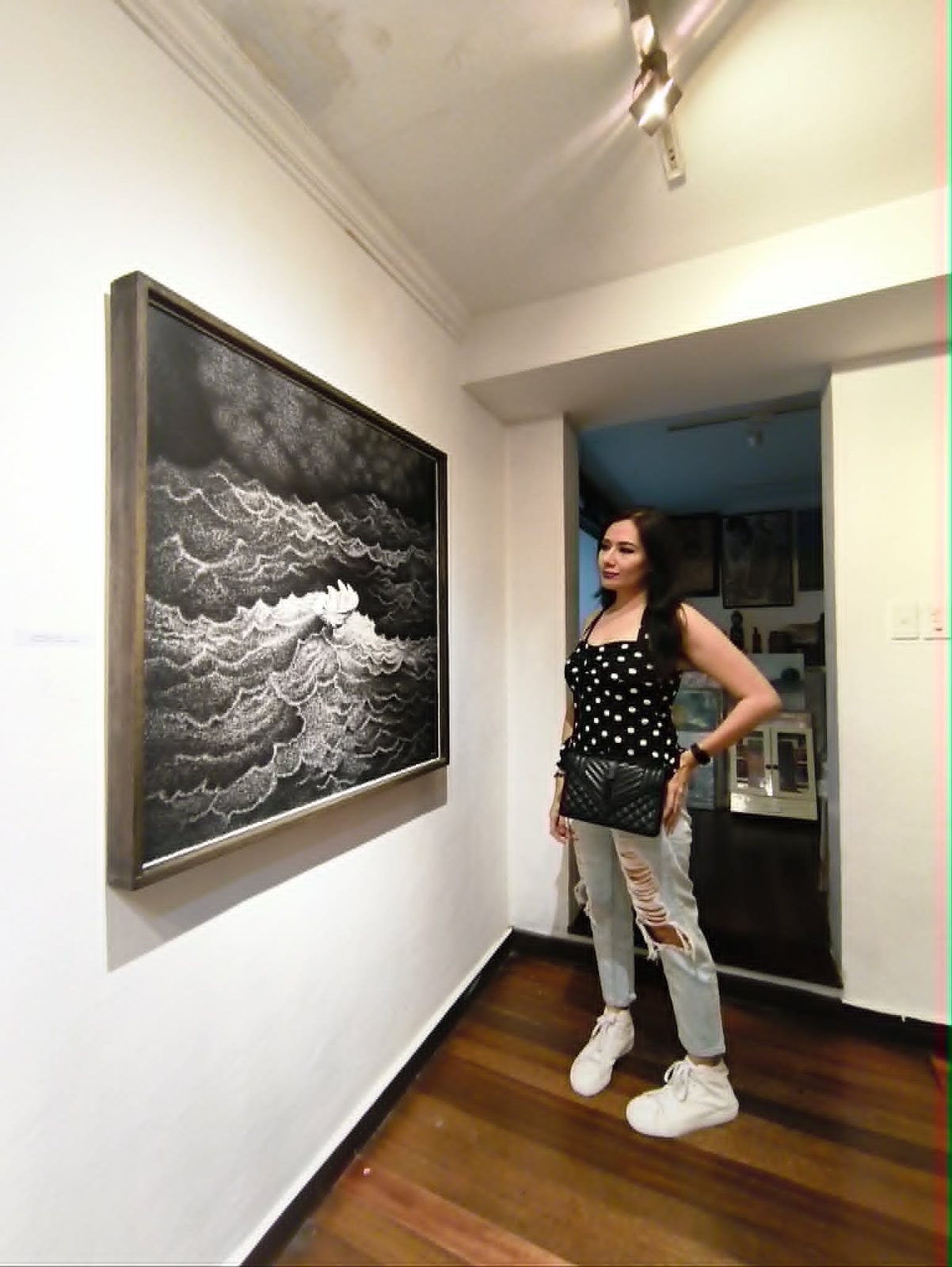
Its counterpart, Lawod (pen and archival ink on canvas, 36 x 36 inches, 2026), titled with the deep-water word — lawod is not the sea you swim in but the open sea, the serious sea, the sea past the reef where the depth stops being a number and becomes a fact — is the image chosen for the exhibition poster, and rightly. A vast night ocean, wave upon stippled wave to the horizon, rendered in perhaps the most astonishing pure draftsmanship in the show; and riding one crest, dead center, tiny and luminous, a clam-like shell holding a pearl — recalling the taklobo, the Philippine giant clam, a small treasure in the middle of the deep. Rather than conquest or escape, it suggests what the sea quietly keeps: inheritance, beauty, survival, and value formed under pressure. The pearl is the thing the poor sea still hides from the powerful — grown slowly, in the dark, out of an irritation the creature could not expel and chose instead to make luminous.
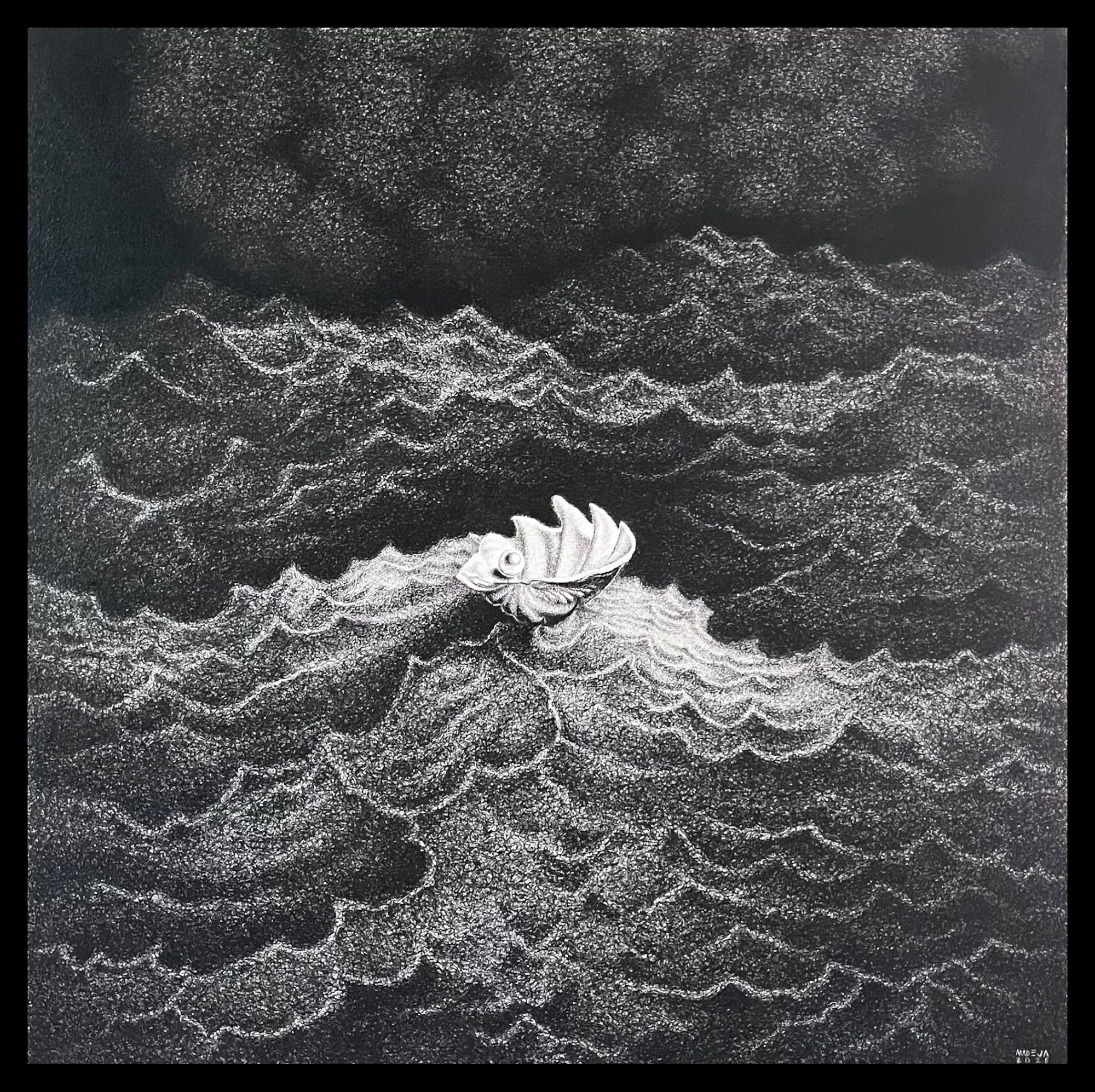
That is the thesis of Walang Katapusang Alon sa Dagat, floated in a single shell. The waves do not end. The curator Carlomar Arcangel Daoana, in his luminous exhibition notes, observes that the sea here becomes a talinghaga — a parable — of a nation in perpetual motion, where history repeats “in the form of different seasons and different faces of power,” and where hope is offered “not as an easy promise but as a kind of endurance.” The pearl is that endurance given a body: value formed, slowly and in the dark, by the very pressure meant to destroy it. So, of course, is the artist.
Walang Katapusan
Because here is the thing I could not stop thinking about as I moved through the Boston Art Gallery on opening night, July 4, among the balut of collectors and painters and one former fisherman in a white shirt standing slightly apart from his own achievement, the way islanders stand apart from their own weather:
Jonathan Madeja was supposed to be a statistic. The son of Alad fisherfolk, no art school, no connections, hauling nets and then hauling appliances and then hauling himself through Manila’s factories — every current in this country’s economy was pushing him toward invisibility. He answered with the most invisible tool we make, the ballpoint pen, and the most invisible technique there is: the scribble, the doodle, the mark of the bored student and the waiting clerk. And he repeated that humble mark — walang katapusan, without end, wave after wave after wave — until it became cathedrals of tone, until it became Rizal’s undeceived eyes and a sleeping boy’s paper crown and the scaled heart of his father’s trade, until the accumulated patience of it filled a gallery in Cubao and made grown Filipinos stand very still and blink hard at drawings of tin cans.
The endless waves in the title are the ones that break on Alad, yes, and the ones that carry gunboats, and the ones that keep returning the same dynasties to the same palaces like debris after a storm. But they are also his own million strokes of ink. The sea repeats itself, and so does he — and in that contest of repetitions, the fisherman is winning. Empires have come at us over that water for five centuries, and we are still here, mending, rowing, crowning our sleeping children, holding our small lights in the dark with both hands.
The waves have no end. Neither, it turns out, does the man drawing them.
Taya ka. Your move.